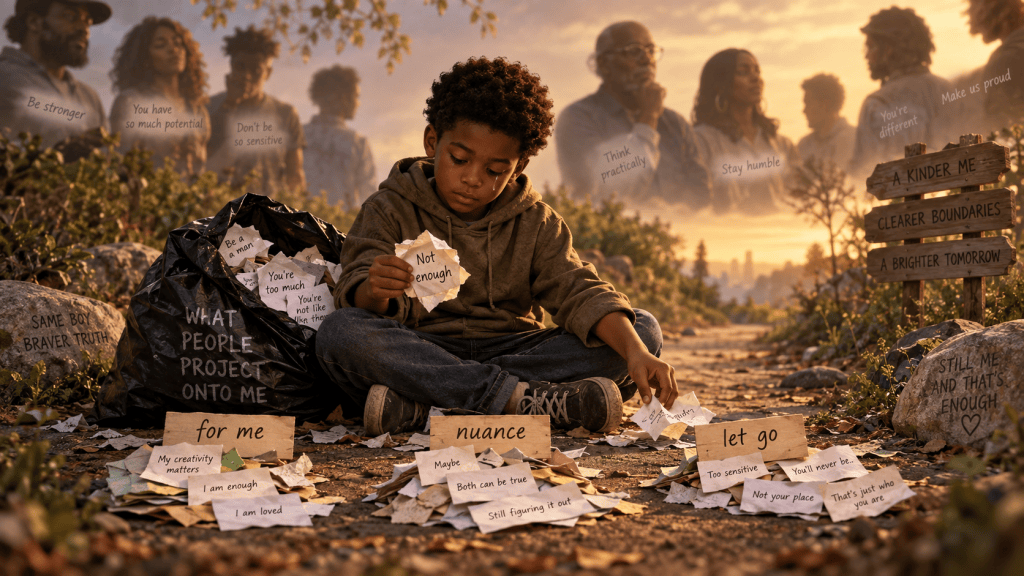
On self-validation, relationships, access, and the fear of becoming so self-sufficient that I stop letting people matter.
I woke up from a nap thinking about some great news I recently received and how I felt after sharing it with people close to me.
Not just about the news itself, but about their reactions to it.
It made me think about how much meaning I sometimes place on the way people respond to the things that matter to me. A part of me can know that someone is proud of me, happy for me or genuinely cares, while another part is still looking for something tangible that lets me feel it.
And that thought sent me somewhere deeper.
One thing I keep having to remind myself is that people’s life experiences are different from mine. Even when we have similar experiences, they can land differently.
The way I understand love, care, reassurance, celebration, disappointment and connection has been shaped by what I’ve lived through. Other people are entering relationships with their own histories too.
And I think I’m finally learning how much that matters.
Sometimes I Know What’s True, Even When I Can’t See It
There are people in my life who are genuinely proud of me.
People who are happy when good things happen for me and sad when bad things happen.
Whether they say it every time or not, I know that to be true.
There was a time when that would have been very difficult for me to believe without evidence.
I would have needed words. A reaction. A celebration. A message. Something I could point to and say:
“See? This person cares.”
As I get older, I’m realizing things aren’t always as apparent as I would like them to be.
And if I’m being fair, I have probably loved people quietly too.
There have probably been moments where I felt something deeply for someone and assumed they knew without me ever giving them evidence of it.
But I’ve also noticed something about myself.
When I realize there’s something I could communicate better — something that might make another person feel seen, validated, reassured, appreciated or celebrated — I usually try to change my behavior.
Because I know what words can do.
Telling someone, “I see how hard you worked on this,” can matter.
Saying, “I’m proud of you,” can matter.
Naming the effort you see in someone can make them feel less invisible.
Sometimes even explaining how you experience a person gives them something they didn’t know they needed.
And when I know those things matter to someone I care about, I try to become more intentional about giving them.
In some ways, I become that person in their life.
And lately I’ve been asking myself a harder question.
Do I have people who do that for me?
The answer is yes.
But do I have it in the ways I would like it to be vocalized, celebrated and recognized?
Not really.
When Self-Validation Starts Changing the Equation
This is where this phase of my life gets complicated.
I’m becoming more aware of the things I have spent years hoping other people would give me — reassurance, recognition, celebration, the feeling of being seen, the feeling that someone is paying enough attention to notice when something matters.
And slowly, I’m learning to give more of those things to myself.
That sounds like growth.
And I think it is.
But there is a part of that growth that scares me.
Because I’m also realizing how much influence I have allowed other people to have over how I experience myself.
Maybe power isn’t even the right word.
Maybe access is closer.
I have allowed people access to whether I feel celebrated, desired, accomplished, secure, important or seen.
When those things weren’t expressed externally, even when I intellectually knew what was true, I still found myself looking around for evidence.
It’s like being in a courtroom where I already know the verdict, but somehow I’m still uncomfortable because nobody brought the exhibits for the jury.
I know I’m loved.
I know some people are proud of me.
I know some people care deeply about me.
But sometimes the evidence is quiet.
And now I’m learning to create some of that evidence for myself.
I can be proud of me.
I can celebrate an accomplishment.
I can acknowledge how difficult something was without waiting for somebody else to notice.
I can reassure myself when I’m afraid.
I can become more responsible for the way I experience my own life.
And there is something incredibly freeing about that.
But freedom introduces another question.
What Happens When I Get Really Good at Giving It to Myself?
What happens when I become really good at giving myself what I used to desperately seek from other people?
Do I become more secure in my relationships?
Or do I slowly start deciding I don’t need them?
That’s the part I’m trying to understand.
Because there is a version of self-sufficiency that feels healthy to me.
A version where I no longer require another person to constantly reassure me of my worth before I can believe it.
But there is another version that feels much more dangerous.
The version where I start thinking:
If I have to validate myself, celebrate myself, reassure myself, encourage myself and continually explain another person’s care to myself… then what exactly is the relationship adding to my life?
And I don’t think that question is wrong.
But I know I have to be careful with what I do with the answer.
Because I know myself.
When something becomes important to me, I can become very black-and-white about it.
Once I identify a pattern that hurts me, my instinct can be to correct it aggressively.
Sometimes so aggressively that the correction becomes its own problem.
If the lesson is, “Stop depending so heavily on other people for validation,” I know there is a part of me capable of taking that all the way to:
“Then I shouldn’t depend on anyone for anything.”
If the lesson is, “Be more selective about who gets access to you,” I can imagine myself turning selectivity into distance.
If the lesson is, “Stop over-investing in people who don’t reciprocate,” I can see how easily that could become keeping a mental ledger of what everyone contributes.
That is the difficulty I’m sitting with.
I don’t want self-love to become another form of hyper-independence.
I don’t want discernment to become isolation.
I don’t want standards to become walls.
But I also don’t want nuance to become the excuse I use to remain chronically underfed in relationships.
Somewhere between those two extremes is probably where I need to live.
Understanding Someone Doesn’t Make Us Compatible
Part of this requires accepting something that is uncomfortable for me:
People can love me without loving me the way I would naturally love them.
Someone can be proud of me and rarely say it.
Someone can care about me and still be inconsistent in expressing that care.
Someone can genuinely value me and still have a relational style that leaves me wanting more.
That doesn’t automatically make them a bad person.
It also doesn’t automatically mean I have to be satisfied.
I think I used to believe that understanding someone was supposed to eliminate my disappointment in them.
If I could understand why they communicated the way they did, why they struggled with reassurance, why they weren’t expressive, why they needed space, why certain things didn’t come naturally to them — then somehow I should be able to stop wanting those things.
But I’m realizing something:
Understanding and compatibility are not the same thing.
I can understand someone completely and still realize that being in relationship with them requires me to regularly live without things that are important to me.
And that realization is difficult because it removes the villain.
There is no one to blame.
There may simply be a difference between what someone genuinely has to offer and what feels nourishing to me.
That may be one of the biggest things I’m learning.
The question isn’t always:
“Do they love me?”
Sometimes the better question is:
“What is it actually like for me to be loved by this person?”
Because those are not the same question.
A person’s feelings can be genuine while my experience of the relationship is still lonely.
A person can have good intentions while I continually feel unseen.
I can believe someone when they tell me they care and still want to experience more evidence of that care inside the relationship.
Both things can be true.
Connection Does Not Automatically Mean Closeness
There is another pattern I’m becoming more aware of.
I bond with people through shared experiences.
A vulnerable conversation.
A sexual experience.
Similar trauma.
A common interest.
A moment where someone seems to understand a part of me that other people don’t.
Those moments can feel very significant to me.
And sometimes I make the relationship significant before the relationship itself has actually demonstrated that significance.
I start relating to possibility.
Potential.
The closeness that could develop.
The role I imagine the person might eventually occupy in my life.
And because I experience connection deeply, it can be easy for me to assume that the other person understands the relationship through the same lens.
Then my feelings get hurt when their behavior reflects something smaller than what I imagined.
That doesn’t always mean they deceived me.
Sometimes I assigned meaning faster than the relationship earned it.
That’s something I want to change.
Letting Relationships Reveal Themselves
I want to learn to let relationships reveal themselves.
Not through one profound conversation.
Not through chemistry.
Not through shared pain.
Not because someone needs me.
Not because I see potential in them.
But through consistency.
Through time.
Through how they show up when nothing dramatic is happening.
Through the amount of space they actually choose to make for me in their life.
I want to stop confusing potential with capacity.
I want to stop assuming that because I feel connected to someone, they automatically belong close to me.
And I want to stop giving people access based only on what I believe the relationship could become.
That is probably what becoming more particular about people needs to mean for me.
Not cutting everyone off.
Not demanding perfection.
Not requiring people to love exactly like I do.
But becoming more honest about what each relationship actually is.
Maybe someone is a good friend but not someone I should emotionally rely on.
Maybe someone loves me but is not capable of providing the kind of reassurance I need from an intimate partner.
Maybe someone is wonderful to spend time with but shouldn’t have unrestricted access to my vulnerability.
Maybe a connection can be meaningful without needing to become central to my life.
I think that level of discernment is uncomfortable because it requires me to stop using feelings alone to decide where people belong.
And feelings have always been very persuasive evidence for me.
So Where Does That Leave Me?
I don’t want people to be responsible for creating my sense of worth anymore.
But I also don’t believe relationships are supposed to become emotionally irrelevant once I learn how to love myself.
I want to be able to celebrate myself and still notice who celebrates with me.
I want to reassure myself and still experience the comfort of reassurance from someone I love.
I want to know I’m worthy without needing someone else to constantly prove it, while still believing that love should sometimes leave evidence behind.
Maybe that is the challenge of this phase of my life.
Learning how to need people without needing them to define me.
Learning how to want things from relationships without making another person responsible for my entire emotional world.
Learning how to understand someone’s limitations without automatically making their limitations acceptable for me.
Learning how to give myself what I need without using that ability as evidence that I should stop expecting anything from anyone else.
And learning that becoming more selective doesn’t have to mean becoming less loving.
Maybe it simply means allowing people to occupy the place in my life that their actions actually support.
I don’t need other people to tell me who I am.
But if you are going to be close to me, I still want to experience you.
Your care.
Your pride.
Your affection.
Your effort.
Your presence.
Not because I cannot survive without it.
But because relationships should feel like something.
And I think what I’m learning now is how to stop giving people the power to determine my worth without becoming so self-contained that no one is ever given the opportunity to add something meaningful to my life.
 Changing Perspectives