I’ve been thinking about some things lately.
Self-reflecting. Watching TikToks and Reels. Sitting with my own patterns. And somewhere in all of that, something clicked.
A lot of what I’ve been learning lately has been about seeing relationships for what they actually are — not just what I hope they’ll become, not just what someone says they intend, and not just what I feel the connection could be.
I’ve written about that before.
But lately, my perspective has been shifting a little further.
Because I’m realizing that sometimes I make it harder for myself to see a relationship clearly.
Not because I’m ignoring what’s happening.
But because I’m so busy filling in the gaps.
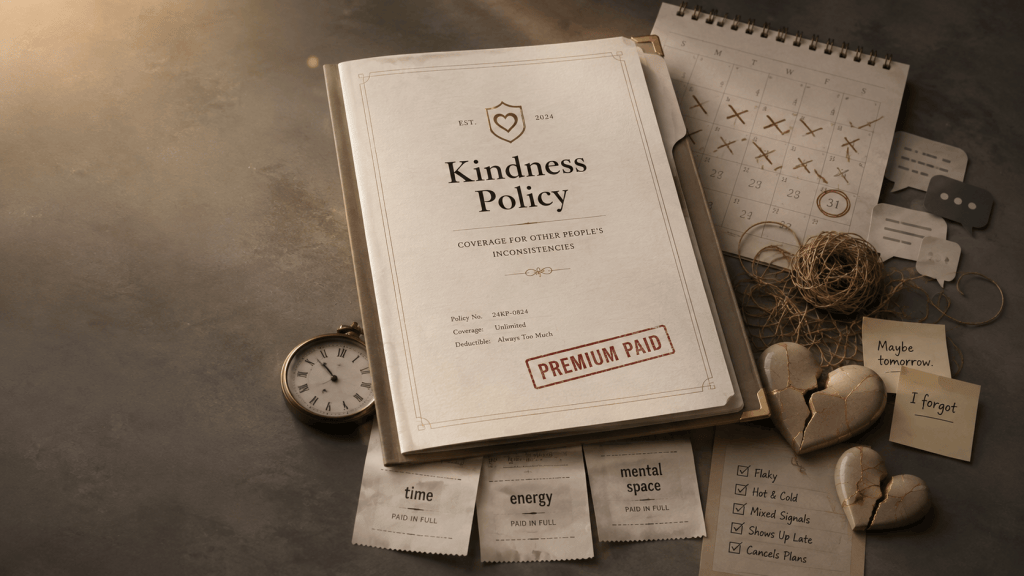
I’ve been turning my kindness into insurance for other people’s inconsistencies.
I’ve always valued being dependable. If I say I’m going to do something, I try to do it. If I care about someone, I show up. If something needs to be handled, I usually figure out how to handle it.
And when I sit with that a little longer, I can see where some of it may come from.
Maybe being disappointed so many times by my daddy, mummy, siblings, friends — people I wanted love, consistency, or connection from — taught me to become the person I wished I had.
Maybe somewhere along the way, showing up became more than kindness. Maybe it became proof of my value.
If I’m dependable enough, useful enough, thoughtful enough, present enough… maybe people will keep me around.
There goes that longing for connection again. That old instinct to make myself valuable so I feel harder to lose.
Whew.
Because I don’t think every act of kindness comes from a wound. I genuinely like being someone people can count on. But I’m learning to notice when my kindness is freely given versus when it’s quietly trying to secure closeness, reassurance, belonging, or permanence.
But anyway… before I turn this into a completely different therapy session, let’s get back on topic. 😂
What I’ve started asking myself is: what happens when my dependability becomes the thing that keeps someone else from having to be dependable with me?
If you forget, I remember.
If you don’t make the plan, I make it.
If you don’t follow through, I adjust.
If you leave a gap, I fill it.
And eventually, without meaning to, I can teach people that they don’t necessarily have to show up consistently because I will always cover the difference.
That’s the part I hadn’t fully considered before.
I’ve spent a lot of time learning to pay attention to people’s actions.
Now I’m learning that sometimes I have to stop interfering with the evidence.
Interfering with the Evidence
One place I’ve been practicing this is in my friendships.
I realized I’m often the one maintaining the connection — reaching out when someone crosses my mind, following up after we say, “We need to hang out,” and eventually organizing the next outing.
So I created a boundary for myself:
I don’t have to act every time I feel the desire for connection.
Someone can cross my mind without me immediately texting them.
We can both say we want to see each other again without me automatically becoming responsible for making it happen.
And no, this isn’t the old me going, “Well, I guess we’re not friends anymore.” 😂
It’s not a test either.
It’s me giving the relationship enough room to show me what it actually is.
Because how someone shows up gives me information — about their interest, their patterns, and their capacity.
Capacity vs. Intention
When I say capacity, I mean someone’s actual emotional, mental, practical, and relational ability to participate in a relationship in a certain way.
And capacity isn’t always the same thing as intention.
Someone can genuinely care about me and still not have the capacity for the kind of closeness I imagined us having.
They can mean it when they say they want to see me more and still rarely make plans.
Their intention may be real, while their actions still tell me what the relationship can realistically hold.
That distinction has been important for me because I used to assign meaning to relationships based heavily on how I felt.
If I felt close to you, I could start treating the friendship as though we shared the same depth, priority, or expectations.
Then real life would come along and remind me that the relationship I felt I had and the relationship we were actually living were not always the same.
Now, instead of immediately cutting someone off or working harder to create the closeness I want, I’m trying to see the relationship for what it is.
That doesn’t mean I never ask for more.
If I want deeper connection, I can communicate that.
If I miss someone and want more intentional time together, I can say that.
The difference is learning when I’m expressing a genuine desire for connection versus when I’m doing all the work to manufacture one.
And friendship is only one example.
The larger practice is learning not to automatically fill every gap someone leaves behind.
Which sounds very mature and peaceful when I write it like that.
In practice? Whew. 😂
Punishment Wearing a Growth Outfit
Because disappointment can bring out another side of me.
Sometimes I want to be passive-aggressive.
Sometimes I want to withdraw so someone can “see how it feels.”
Sometimes even letting them can become punishment.
And technically I may be “leaving it alone,” but internally I’m waiting for you to notice. Waiting for you to feel my absence. Waiting for you to realize you disappointed me.
That isn’t always a boundary.
Sometimes that’s just punishment wearing a cute little self-growth outfit. 😂
And I’m trying to be honest with myself about that too.
Because there’s a difference between giving someone room to show you who they are and silently creating a test they don’t know they’re taking.
There’s a difference between saying, “I’m not carrying this for both of us anymore,” and “Now I’m going to make sure you feel what I felt.”
The work for me is learning to leave something where it is without turning that decision into a weapon.
I can communicate.
And then I can observe.
Sometimes what I see will reassure me.
Sometimes it will disappoint me.
Sometimes it will show me someone cares deeply but has limited capacity.
Sometimes it will show me their intentions and actions simply don’t align.
Either way, I get information I might have missed if I had immediately stepped in to cover the gap.
And honestly, there has been something unexpectedly freeing about this.
I feel lighter.
Less anxious.
Less consumed with whether someone is going to follow through, whether I should reach out, whether I need to fix something, or whether I’m supposed to keep the relationship moving.
There are moments where I catch myself realizing, I’m not even worried about this anymore.
And if I’m honest, that scares me a little too.
Because sometimes that peace can almost feel like I don’t care anymore.
And for someone who has spent so much time caring deeply, thinking deeply, anticipating, checking, fixing, and trying to maintain connection, not carrying all of that can feel unfamiliar enough that I start questioning myself.
Am I becoming detached?
Am I shutting down?
Do I care less?
Or am I just finally learning that caring about someone does not require me to constantly manage the relationship?
I think that’s the part I’m still learning to recognize.
Peace can feel like indifference when anxiety has been your evidence that something matters.
Maybe I haven’t stopped caring.
Maybe I’ve just stopped believing that caring requires me to be constantly activated.
Sometimes I can simply remind myself:
They know.
They said they would.
I’ve communicated.
Leave it there.
And then go live my life.
That feels different.
Sometimes strange.
Sometimes scary.
But also really, really light.
The Cost of the Premium
I don’t want to become less kind.
I don’t want to become less dependable.
Those are parts of myself I genuinely love.
I just don’t want my kindness to keep functioning as insurance against other people’s inconsistencies.
Because for a long time, I think I’ve been the one paying the premium.
Paying with my time.
My energy.
My mental space.
My disappointment.
All to make sure the relationship stayed covered.
And maybe this is simply the next stage of something I’ve already been learning:
First, I had to learn to see relationships for what they are.
Now I’m learning to stop doing so much that I prevent them from showing me.
I can still love people.
I can still show up.
I can still communicate what I need and give people room to meet me there.
But I’m no longer interested in paying the premium just to insure a relationship against the truth of how someone actually shows up.
Sometimes the policy needs to lapse.
What would my relationships look like if I stopped covering the difference and simply allowed people to show me what they’re willing and able to contribute?

