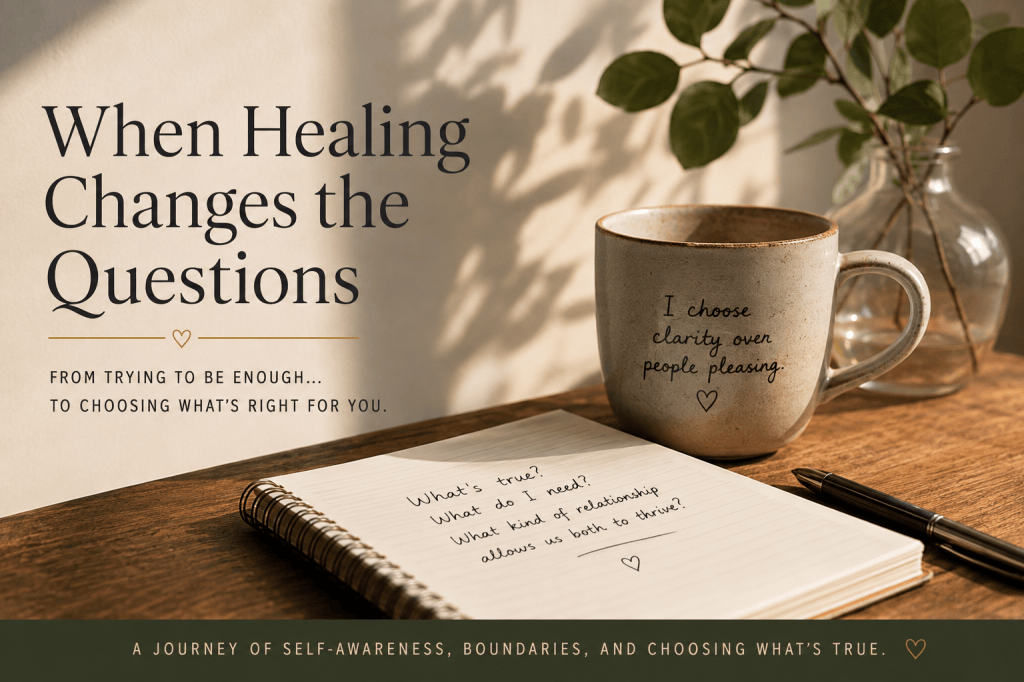
There was a time when every conflict sent me inward.
Maybe I’m asking for too much.
Maybe this is my anxious attachment.
Maybe I need to communicate better.
Maybe I need to be more patient.
Whether it was a romantic relationship, a friendship, or someone I deeply cared about, every painful interaction became another opportunity to fix myself. I believed that if I healed enough, understood enough, communicated well enough, then my relationships would finally feel secure.
Healing did change me.
Just not in the way I expected.
I thought healing would make me easier to love.
Instead, it made me more honest about the love, care, and consistency I need from the people I choose to keep close.
A Moment on Self-Awareness
Self-awareness is the ability to honestly observe your own thoughts, emotions, behaviors, motivations, and patterns without immediately judging or defending them. It means asking, “What part of this belongs to me?” while also being willing to ask, “What doesn’t?”
Self-awareness isn’t about assuming you’re always the problem.
It’s about becoming curious enough to tell the difference between your wounds, your needs, your fears, and your reality.
One of the hardest parts of growth is realizing that self-awareness doesn’t automatically make a relationship work.
You can understand why someone struggles to communicate.
You can empathize with what they’re carrying.
You can appreciate the effort they’re making.
You can love them deeply.
And still discover that the relationship isn’t giving you what you need.
For a long time, I confused understanding with acceptance.
If I could explain someone’s behavior, I felt like I had to make room for it.
But understanding someone’s circumstances doesn’t erase the impact those circumstances have on you.
Both things can be true.
The biggest shift wasn’t that I stopped questioning myself.
I still do.
I still ask whether I’m interpreting things fairly. I still challenge my assumptions. I still wonder whether old wounds are coloring new experiences.
The difference is that I no longer assume I’m the problem.
Now, instead of asking,
“What’s wrong with me?”
I ask,
“What’s true?”
What’s true about me?
What’s true about them?
What’s true about this relationship?
Not the relationship I hope it becomes.
Not the relationship I’ve imagined in my head.
The relationship that’s standing in front of me today.
Healing didn’t take away my desire to be chosen.
It changed what being chosen means.
It’s no longer about hearing the right words.
It’s about seeing someone consistently participate in the relationship they’re asking me to be a part of.
Consistency has become more convincing than chemistry.
Follow-through has become more comforting than promises.
And shared effort has become more meaningful than potential.
There was a time when self-awareness meant looking inward for every answer.
Today, it means looking inward without losing sight of what’s happening in front of me.
That might be the biggest lesson healing has taught me.
Because self-awareness isn’t about becoming so introspective that you excuse everything around you.
It’s about understanding yourself well enough to recognize when your fears are speaking… and when your needs are.
Maybe the biggest surprise of all is that I’m no longer interviewing myself for the role of partner, friend, or person worthy of being loved.
I’m learning to interview the relationship itself.
Not to decide whether someone is “good enough.”
But to ask whether what we’re creating together is something we can both genuinely thrive in.
Because healing isn’t just learning how to stay.
Sometimes it’s learning how to honestly answer the question:
“If nothing changed from here, would I still choose this relationship?”
And allowing yourself to answer without guilt.
Sometimes the answer will be yes.
Sometimes it will be no.
Neither answer makes you selfish.
Sometimes it’s simply the most honest answer you can give.
A Final Reflection
Healing didn’t teach me to stop loving people.
It taught me that loving someone and choosing a relationship with them are not always the same decision.
Love can exist alongside incompatibility.
Compassion can exist alongside boundaries.
Understanding someone doesn’t always mean they’re the right person to walk beside you.
Sometimes the greatest act of self-awareness isn’t asking, “How can I become easier to love?”
Sometimes it’s asking,
“Does this relationship allow me to experience love in the way I know I need?”
And having the courage to accept whatever answer follows.
Before you close this page, I want you to think about the person or relationship that quietly came to mind while you were reading.
Are you experiencing love, care, and connection in the way you genuinely need?
Are you showing up as the version of yourself you’re proud of?
And are you choosing the relationship that’s in front of you… or the one you keep hoping it will become?
You don’t have to answer those questions today.
You don’t even have to answer them for me.
Just answer them honestly…
For yourself.

